Middle Earth: Prompting and narrating like Tolkien from raw GIS data
The database knows the traveller crossed a marsh at 14:00, met a warg (danger 3, stalks), and that it was raining. Somehow that has to come out sounding like Tolkien wrote it, and not like a weather report with adjectives.
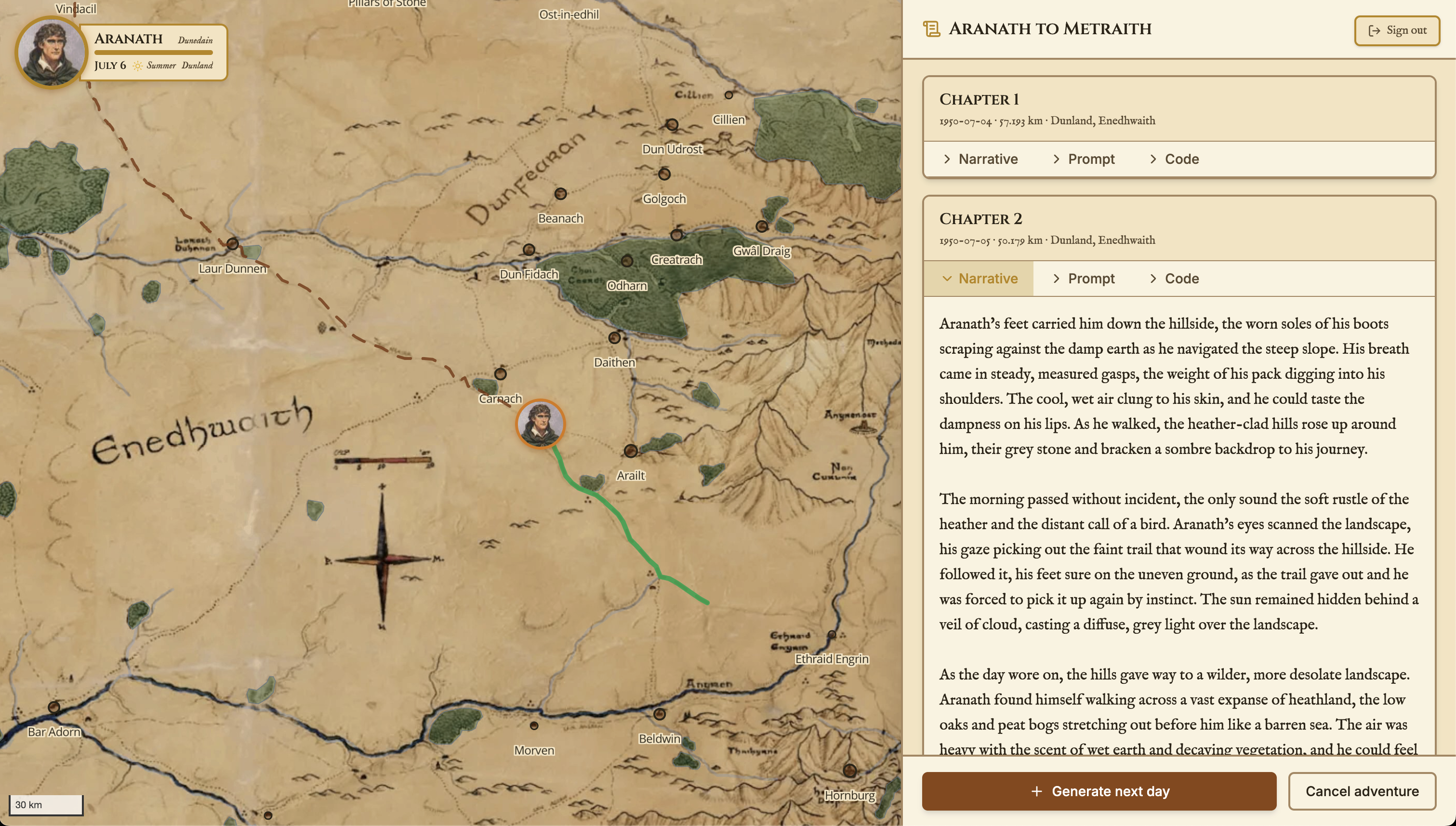
The gap between a row and a sentence
Everything in the previous four articles produces facts. Structured, geographically honest facts:
region: Midgewater; biome: marsh; altitude: plain;
temp_2m: 9.4°C; precipitation: light; phase: afternoon;
encounter: { entity: "Warg", type: "carnivores", danger: 3, form: "stalks" }
Nobody wants to read that. The challenge was turning that packet into a chapter: one day of travel, in flowing prose, in the sober and concrete voice of Tolkien. And doing it without the two classic failure modes of AI writing, which are the weather report (“The temperature was 9.4°C with light rain”) and the purple prose (“A sense of ancient wonder washed over her trembling heart”).
The solution has three layers: turn data into hints (not prose), assemble a strict prompt, and hand it to an LLM on a short leash.
Layer 1: rules turn data into hints, not sentences
Before any AI is involved, a rule-based service (naturalLanguage.js, with help from terrainPhrases.js) converts the raw day into reference notes. These are hints about what is there, never finished prose to be copied.
Region-specific flavour lives in a region_biome_descriptions table — hand-written phrase pools keyed by region and category — and gets sampled with a seeded RNG so the same trip always reads the same way:
// pick a marsh-phrase for whichever region we're in, deterministically
pickPhraseForRegions(phrasesMap, day.regions, 'marsh', day.rng);
The output is a set of labelled note blocks — TERRAIN NOTES, ROAD NOTES, WEATHER NOTES, CREATURE NOTES, LOCATION NOTES — plus water crossings and an elevation-effort summary. Reference material, not a script.
Layer 2: the prompt is a stage, not a suggestion
prompt.js assembles those notes into one carefully staged message. It returns { system, user }.
The system prompt sets the voice. This is the whole personality of the narrator, and it is mostly a list of things not to do:
“You are a storyteller in the tradition of J.R.R. Tolkien. Sober, concrete prose: you name hills, rivers and roads for what they are and let the facts suggest emotion rather than declaring it.”
Its rules, paraphrased:
- Restraint over ornament. No abstract filler (“a sense of wonder,” “his heart pounded”).
- Weather is atmosphere, not a report. It appears only when it changes the mood or blocks the march, and never as figures or exact hours. This one rule solves the weather-report problem.
- Every encounter must MAKE something happen — a decision, an exchange, a consequence. No threats that dissolve into nothing.
- Don’t invent places or creatures that aren’t in the data.
- The notes are RAW MATERIAL, not a checklist. Use what serves the story, discard the rest, and never copy the wording.
The user message stages the day. The day is narrated in three movements — morning, afternoon, night at camp — and the prompt is built from composable sections that only appear when relevant:
NARRATOR'S LENS— the chosen character’s perspective filter. The immortal Elf and the mortal Ranger see the same road very differently.JOURNEY CONTEXT— the ultimate destination + a non-AI summary of yesterday, for continuity.SPECIAL INSTRUCTIONS— a distinct opening for day 1 (departure, motivation) and a distinct closing for the last day (arrival, reflection).DO NOT REUSE— yesterday’s terrain phrases, explicitly banned so the prose doesn’t loop.CHARACTER STATE OF MIND— optional inner thoughts to slip in near-verbatim, in the character’s own voice.TODAY'S WAY IN— one sensory element to build the morning around, with an instruction to start in the middle of an action instead of at dawn with the weather.- The land/road/weather/creature notes, and finally the encounters, phase by phase.
Encounters arrive already decided. This is the main trick for keeping the model honest. The encounter’s form, dialogue topic, character stance and outcome were already resolved by the engine. The prompt hands them over as instructions to render, not choices to make:
* Warg (carnivores, nocturnal) in Midgewater — a lean grey hunter of the fells.
    FORM: stalks. followed unseen from the treeline, closing slowly
    OUTCOME (narrate this, do not change it): wounded.
The model writes the scene; it does not get to decide whether the warg wins. The world already decided that. The AI is a prose renderer, not a dungeon master.
Layer 3: the LLM, on a short leash and with a spare
The finished { system, user } prompt goes to ai.js, which runs a provider cascade with automatic fallback so a rate limit never kills a story mid-journey:
- Gemini 2.0 Flash — primary. (temperature
0.7,maxOutputTokens2048.) - Groq
llama-3.3-70b-versatilewithGROQ_API_KEY— fallback #1. - Groq again with
GROQ_API_KEY_2— fallback #2.
// simplified
const gemini = getGeminiClient();
if (gemini) { try { return await tryGenerateGemini(...); }
              catch (e) { if (!isRateLimitError(e)) return null; } }
// 429? fall through to Groq key #1, then key #2
Only a rate limit (429) triggers a fallback. A real error fails fast instead of quietly trying every provider. Temperature sits at a deliberately low 0.7: enough variation to feel alive, not enough for the narrator to start inventing dragons in the Shire.
Why not just let the AI do everything?
I could have thrown the whole day at a big model and said “write a Tolkien chapter”. It would have produced something plausible and slightly wrong every time: inventing a river here, forgetting the warg there, letting a mortal survive a fall he should not have.
By splitting the work so that rules decide the facts, the prompt stages them, and the LLM only phrases them, the geography stays true, outcomes stay consistent with the game’s own logic, and the model does the one thing it is really good at, which is choosing the right words. The GIS database is the author, the LLM is the ghostwriter.
Lessons from ghostwriting for Tolkien
- Give the model hints, not homework. Passing finished sentences invites copy-paste; passing labelled notes forces fresh prose.
- Constrain by negation. Half the system prompt is “do not,” and that’s what produces restraint.
- Decide outcomes outside the model. Resolving encounters before the prompt is the difference between a consistent world and improvisation.
- Always bring a spare key. A three-provider cascade means that “the AI is down” never becomes “your journey is over”.
- Seed everything. Deterministic phrase-picking means a chapter is a fact about the trip, not a coin flip.
These five articles trace the whole path: shape the ground, give it a sky, let people travel it, fill it with life, and finally teach it to tell its own story. A hand-drawn map, taken as seriously as a real one.
But a narrator that writes one good chapter at a time is not the same thing as a story. Each chapter here is still generated in isolation, with no memory of the ones before it. Fixing that is the next piece of work, and it is the one I am turning into my Master’s final project. → Survival, endings, and turning the narrator into an Interactive Story Engine